
Keynote: creative space in a mental world
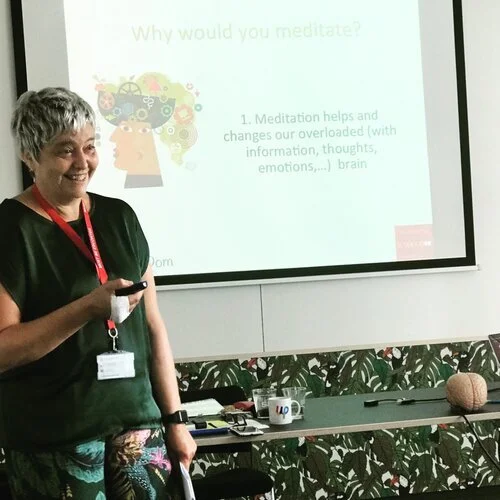
Not a traditional lecture, but an experiential keynote on how fixed mental frameworks limit creativity and decision-making . and how people can develop a new kind of mental clarity.
Each session combines a simple neuroscientific framework with guided experiential moments that allow participants to feel what changes when automatic thinking patterns become less dominant.
Duration: 90 to 120 minutes
Available in Dutch or English.
Today’s work culture is characterized by a high pace, constant analysis, a continuous flow of information, and increasing mental load.
In these keynotes, we explore what happens when automatic thinking patterns become less dominant. And how this reopens the space for cognitive flexibility, clarity, and renewal.
Choose the theme that resonates most with the reality of your team:
Keynote 1: When Urgency Undermines Quality
How to step out of reaction mode and choose direction again
The agenda is full. Messages follow one another. Everything seems urgent.
And yet, work sometimes stalls. Decisions are made more quickly, but not necessarily better. Fatigue quietly enters the team.
Under continuous time pressure, attention narrows. We see less. We listen less. We react faster.
Chronic urgency pushes people into a constant reaction mode. Creativity declines. Complex challenges are reduced to quick answers. People become trapped in their own rhythm.
In this keynote, we explore:
what sustained time pressure does to quality and decision-making
why permanent urgency gradually undermines performance
how reaction mode embeds itself in teams without anyone noticing
what is needed to create space again for overview and direction
This is not a plea to do less. It is an invitation to consciously slow down at decisive moments.
Not to remove momentum, but to remain clear.
So that speed becomes a choice again — not an automatic response.
Keynote 2: Clear Decision-Making in Unsettled Times
On tunnel vision and regaining perspective
Information is not the problem. Overinformation is.
There is always another report to read. Another analysis to conduct. Another angle to explore.
And yet, the choice does not become clearer.
Under pressure, our perception narrows. We reason faster. We fall back on what we already know.
Not because we are careless, but because our perspective becomes smaller.
Even highly intelligent people get stuck in tunnel vision. Not due to a lack of knowledge, but due to a lack of mental space and overview.
In this keynote, we explore:
what stress and time pressure do to perspective and judgment
why more analysis does not automatically lead to better decisions
how clarity emerges when thinking no longer dominates everything
how to regain overview without adding new methods
Decision-making does not require additional techniques. It requires the willingness to step back at the right moment — to widen perspective and reconnect the larger picture.
Not less analysis. But clearer choices.
Keynote 3: When Intelligence Gets in Its Own Way
On mental overload and regaining fresh thinking capacity
Many professionals are cognitively strong, yet mentally fatigued.
Always available. Analyzing. Anticipating.
The mind keeps running, even when the body is already tired.
In the short term, this works. In the long term, something else quietly sets in.
Decisions become predictable. Solutions repeat themselves. New perspectives fail to emerge.
Not because people are not intelligent enough, but because their thinking rarely comes to rest.
In this keynote, we explore:
what continuous mental activation does to clarity and energy
why the same solutions keep recurring
how to recognize mental noise in yourself and in teams
how space opens for new, fresh perspectives
Intelligence functions best when it is not under constant strain.
Not more thinking. Instead: thinking from renewed space in your mind.
Keynote 4: Creativity in a Mental Work Culture
On breaking fixed thinking patterns and opening new perspectives
New solutions do not always emerge from thinking harder. There are valuable brainstorming techniques to stimulate creativity.
But deep innovation begins before technique.
It arises when thinking no longer automatically follows the same tracks.
In this keynote, we explore:
why fixed thinking patterns quietly repeat themselves
why new ideas sometimes fail to emerge
how space opens for original perspectives
how to translate this into daily professional practice
Creativity is not a rare talent. It appears when thinking is no longer running in the same loop.
Not searching harder, but looking differently.
So that new possibilities become visible where they previously went unnoticed.
Would you like to discuss which keynote best fits your team or organization? Or do you have questions?